With a maritime history dating back to antiquity, Port Vauban has long played an important role in shipping, trade and shipbuilding in Antibes.
To preserve and promote this maritime heritage, VAUBAN 21 has created a dedicated pontoon for heritage boats, offering eligible vessels a preferential berthing rate aligned with the tariff for berths of general interest.
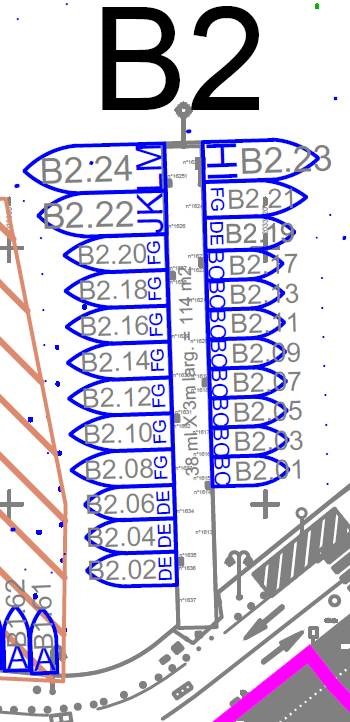
The heritage pontoon is located on Pontoon B2 and can accommodate vessels from categories A to LM, up to 10.99 metres LOA.
Vessels holding a valid BIP (Bateau d’Intérêt Patrimonial) national heritage label, or with an application currently under review, may be eligible for a preferential berthing rate when they demonstrate a local or regional heritage interest.
Access to this preferential rate is subject to the vessel’s participation in events organised at Port Vauban and to its proper maintenance and preservation.
Applications for the Heritage Pontoon waiting list are registered according to the date on which the complete application is received, including the required form and supporting documents.
A confirmation will be sent to the applicant within 30 days of receipt. It will include the information provided in the application, the registration date and the applicant’s position on the waiting list.
The application form for a Heritage Pontoon mooring contract, together with the eligibility conditions, required supporting documents, mooring plan and practical information, is available at the Port Vauban harbour office and can also be downloaded below.
Applications must be completed using the dedicated form, dated and signed, and submitted with all required supporting documents. Owners may also include any additional information they consider relevant to the vessel’s heritage value.
Applications can be:
The application process, management of the waiting list and allocation of annual contracts are governed by the procedure for the Heritage Vessel waiting list and annual mooring contracts.
For further information, please contact Marion LEFEVRE:
Email: patrimoine@vauban21.com
Tel.: +33 (0)4 92 91 60 07
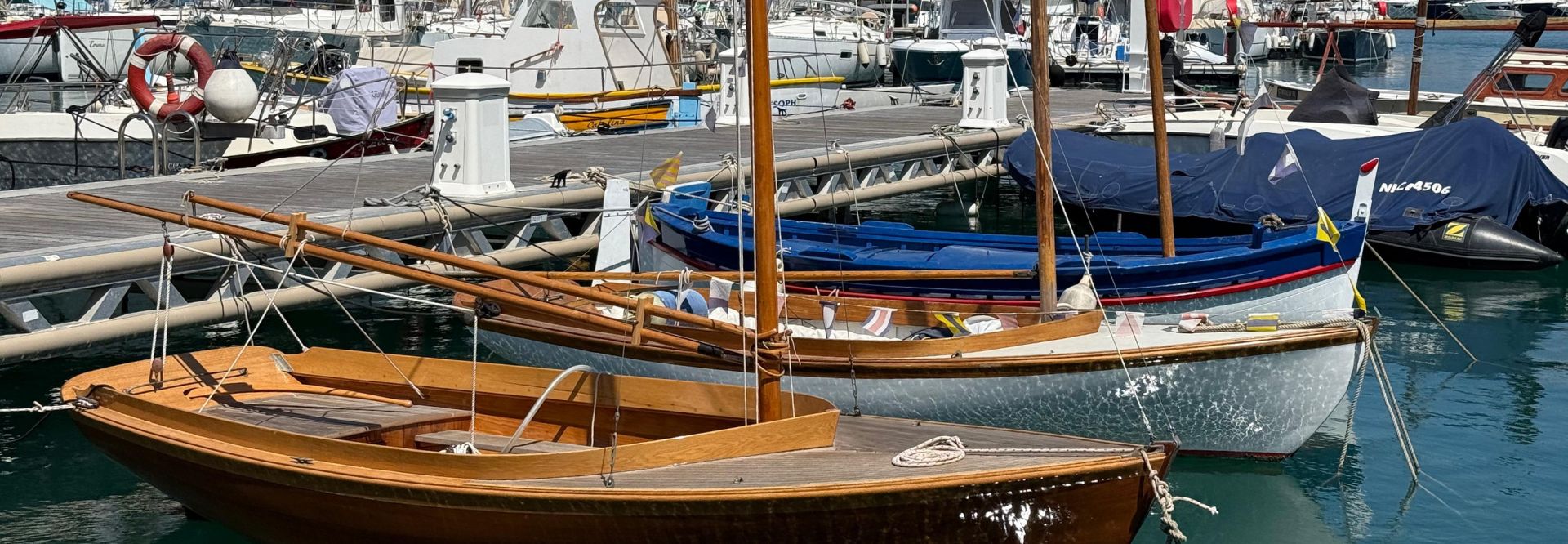
The Nath’Soph is a traditional Mediterranean fishing boat, or sardinier, built in 1966 at the Georges Fracchia shipyard in Antibes.
Commissioned by Louis Génovèse, this 9.74-metre pointu was originally named Henri-Thierry, after the two sons of fisherman Henri Thierry. With its traditional wooden construction and generous dimensions, the vessel reflects the maritime and shipbuilding heritage of Antibes.
Following the retirement of its owner, the boat was sold to a fisherman from Nice. Several years later, Thierry, Louis Génovèse’s son, came across the Henri-Thierry in the Port of Nice in very poor condition. Determined to preserve the vessel, he bought it and brought it back to Antibes, to the shipyard where it had been built around thirty years earlier.
Alain Botéro, successor and son-in-law of Georges Fracchia, undertook an extensive restoration of the traditional fishing boat. After more than 800 hours of work, the pointu was restored to its former condition.
Continuing the family tradition, Thierry renamed the vessel Nath’Soph, in reference to his two sons, Florent and Lionel.
After many years as a working fishing boat, Nath’Soph began a new chapter as a pleasure craft when it was acquired by Mr and Mrs Serge Heurtebise. In 2021, Aventure Pluriel purchased the vessel and carried out a new restoration at the Campanette shipyard in Cagnes-sur-Mer.
Today, Nath’Soph is once again moored at Port Vauban in Antibes, where this BIP-classified heritage boat is used as a collective vessel for guided tours and sea trips for association members.
Based in Antibes since 2018, One Wave is a classic racing yacht that reflects the excellence of Mediterranean yacht design and local shipbuilding heritage.
This wooden 6mJI sloop, built with mahogany planking and bent ash frames, was designed by renowned Cannes naval architect François Camatte, who created numerous international racing yachts in the 6mJI, 8mJI and 5mJI classes. One Wave was built at the Attilio Chiesa et fils shipyard in Cannes and is equipped with a Marconi rig.
From the beginning, the yacht’s history has been closely connected to French maritime heritage. One Wave was built to represent France at the 1948 Olympic Games in London, the first Olympic Games held after the Second World War.
Following an extensive restoration carried out between 2016 and 2018 by her current owner, One Wave returned to competition and has since taken part in many of the leading classic yacht regattas in the Mediterranean.
In 2019, One Wave won several events, including Les Voiles d’Antibes, finishing ahead of the 8mJI Caron, a four-time world champion.
In 2021, she won the prestigious Monaco Classic Week and finished second in the annual AFYT Classics Championship among 57 classified boats.
In 2022, One Wave won the Ladies’ Regatta in Saint-Tropez with Alexia Barrier at the helm and once again claimed victory at Les Voiles d’Antibes.
Today, One Wave contributes to the preservation and promotion of classic sailing and maritime heritage in Antibes.
Based in Antibes since 2022, Cirrus II is a traditional Mediterranean barquette built in 1961 by the Chantier Chabert in Marseille, according to a design by naval architect André Mauric.
Carefully restored in keeping with traditional boatbuilding techniques, Cirrus II reflects the craftsmanship and maritime heritage of the Mediterranean coast.
The hull, including the planking and ribs, as well as the deck and superstructure, are made of wood, while the portholes are made of bronze. The vessel is ballasted with lead and equipped with an auric rig and a 2.80-metre bowsprit.
Classified as a Boat of Heritage Interest (BIP), Cirrus II contributes to the preservation and promotion of traditional Mediterranean boats and maritime heritage at Port Vauban in Antibes.
Based in Antibes since 2017, Kerala reflects the development of modern recreational sailing and the tradition of the classic day boat.
This elegant laminated-wood sloop, built from oak and mahogany, is based on the renowned Herreshoff 12½ design created by American naval architect Nathanael G. Herreshoff in 1914.
In 1985, naval architect Joël White adapted the original design into a ballasted dinghy known as the Haven 12½. He also developed a set of construction plans and a dedicated building guide, inspired by traditional Herreshoff boatbuilding methods, including upside-down construction on moulds.
Kerala was built by her current owner at the Nautique Sèvres shipyard, following traditional craftsmanship and using high-quality materials including oak, mahogany, spruce and Douglas fir.
Many of the bronze fittings come from the Ballentine’s Boat Shop in Maine, USA, while several fittings were produced in Antibes with the participation of Pascal Papalia.
Rigged with a houari sail plan, Kerala is equipped with Dacron sails made by Jean Chevalier, master sailmaker in La Frette-sur-Seine.
Today, Kerala contributes to the diversity of traditional and heritage-inspired boats at Port Vauban, showcasing both classic yacht design and traditional wooden boatbuilding craftsmanship.
Based in Antibes since 2021, Whistle reflects the long tradition of wooden boatbuilding and local maritime craftsmanship in Antibes.
Originally ordered in 1932, Whistle was built and delivered in 1936 by the De Stefano shipyard in Antibes. This traditional wooden pointu, built with pine planking and oak ribs, bears witness to the region’s historic Mediterranean boating traditions and local shipbuilding heritage.
Whistle underwent an extensive restoration in 2020 at the Monaco Marine shipyard in Antibes, helping preserve the vessel’s traditional character, construction techniques and craftsmanship.
The boat belongs to Mr and Mrs Townshend, who also own other vessels of heritage interest moored at Port Vauban.
Today, Whistle contributes to the preservation and promotion of traditional Mediterranean boats and Antibes’ maritime heritage at Port Vauban.
Catalina is a traditional Corsican barquette that reflects the history of local shipbuilding in Corsica and the important role of fishing in the region’s maritime heritage.
Built in 1972 at the Ausilia Frères shipyard in Calvi, Catalina was originally designed for lobster fishing. After 2000, she was used by the Calvi Nautical Club as a training vessel for traditional lateen sailing.
In 2006, Catalina was acquired and restored by the Aventure Pluriel association, with the support of the Conseil Général des Alpes-Maritimes. Today, she is used for introductory and advanced lateen sailing courses open to the public, helping preserve and pass on traditional Mediterranean sailing techniques.
Catalina is rigged with two lateen sails: a 36 m² mestre carried on a large antenna and a 14 m² polacre. She is also equipped with an arrow sail and a trinquet.
Classified as a Boat of Heritage Interest (BIP), Catalina contributes to the preservation and promotion of traditional Mediterranean boats, Corsican maritime heritage and lateen sailing culture.
Pinguino is a classic Haven 12½ wooden sloop, built in 1996 by the renowned Eric Dow Shipyard to a design based on the original 1914 plans by American naval architect Nathanael G. Herreshoff.
Measuring almost 5 metres in length, Pinguino features an oak and teak hull and reflects the craftsmanship and elegance of traditional wooden yacht construction.
The vessel has been carefully maintained by her current owner, Jean-Louis, a marine carpenter, helping preserve her original character and traditional construction.
Pinguino is moored alongside Kerala, her sister ship, creating a natural link between two boats inspired by the celebrated Herreshoff design tradition.
Together, these vessels contribute to the preservation and promotion of classic wooden sailing and maritime heritage at Port Vauban.
Maracuja is a classic Mousquetaire sailing boat designed by French naval architect Jean-Jacques Herbulot for the renowned Glénans sailing school.
Designed as a compact cruising boat capable of accommodating up to five crew members, the Mousquetaire became known for its robustness and excellent seaworthiness. More than 800 examples were built, contributing to the development of accessible recreational sailing in France. A dedicated “Club” version was later introduced in 1974.
Built in 1964, Maracuja was number 27 in the first series of Mousquetaires. The vessel reflects the growth of small-group recreational sailing during the 1960s and forms part of the history of French yachting and traditional boatbuilding.
In 2006, Maracuja was acquired by the Aventure Pluriel association. Since then, the boat has undergone several restorations and has been based in Antibes since 2021.
Equipped with a retractable centreboard and a ballasted short keel, Maracuja is rigged as a Bermuda sloop.
Classified as a Boat of Heritage Interest (BIP), Maracuja contributes to the preservation and promotion of French sailing heritage and traditional recreational boating at Port Vauban in Antibes.